


At the end of the summer when the garden is overflowing with basil, it’s the perfect time to start drying basil to stock your pantry. Fortunately, you don’t need any special equipment to dry basil.
Let’s chat about the different methods of drying basil – air dry, dehydrator, oven method, microwave and air fryer – and the pros and cons of each method.

I like to grow basil plants along with our other summer vegetables such as tomatoes and squash. They make great companion plants. And help keep pests away.
All through the summer, I’ll harvest small amounts of basil to make pesto for our Friday night pizza, to cook with, or add to tomatoes while I’m canning them. The frequent harvesting helps the plants bush out and produce more leaves.
Towards the end of the summer, I’ll do a large harvest and cut the plants back by about two-thirds. I’ll use this harvest to make freezer pesto and stock the herb cabinet for winter.

Harvesting and Preparing Fresh Basil for Drying
Basil is best harvested before it starts to flower as it can get bitter. That being said, if the basil has started to flower, I’ll still harvest it and use it. I’ve never been able to tell a difference.
Use scissors or garden clippers when you harvest basil. The leaves bruise easily and can oxidize and turn black. They’ll also lose some of their flavor.
I like to clip the stems off instead of just pinching off the leaves. I do this even when I’m only harvesting a little to just immediately. This will help the plant get bushy.
Once it’s harvested, basil need to be cleaned and preserved fairly quickly. Basil has a tendency to oxidize and turn black wherever there is a bruise, and sometimes where there isn’t a bruise. I like to get it all processed within an hour of harvesting.
If I harvested a lot of basil, I’ll fill a sink with cold water and put it all in the sink. Swish it around a bit and you’ll start to see dirt in the water. Occasionally there will be bugs that were hidden in the basil that need to be removed.
Next pinch the leaves off the basil and put them in a salad spinner. Once it’s full, spin the basil leaves to remove any excess water.
If you don’t have a salad spinner, or if you’re going to dry the basil in bunches, use several clean kitchen towels and pat the basil dry.
Now, the basil is ready for drying.

How to Dry Basil
I think most people will agree that while dried basil is good, it doesn’t have nearly the flavor that fresh basil does. Because of that, drying basil is not my favorite way to preserve basil.
However, I do like to keep dried basil on hand during the winter to quickly add to things I’m cooking or canning. So every summer I harvest and dry basil.
I’m often asked if it’s better to use an oven or dehydrator to dry basil. My answer is, “Use what you have.” The process will be a little different depending on if you use an oven or dehydrator (or air dry) to dry the basil. But the end result will be the same.
So, don’t get hung up on what’s “best.”
Pro Tip: Do NOT chop basil before drying, as it will be more likely to discolor. If you want chopped dried basil, crumble the dried leaves.

Air Drying Basil
Yes, you can air dry fresh basil. In my opinion, this gives the best end results. BUT you need to know a couple of things first.
Fresh basil has a high water content, so if you choose to dry basil by hanging and air drying it, be sure to bundle it in small bundles. Basil has a tendency to mold, and you don’t want that.
To air dry fresh basil bunches:
- Using twine, tie 3-4 stems together. I like to tie the twine a second time, to act like a loop for hanging – kind of like you do with with Christmas ornaments.
- Hang the stems in an area that is out of direct sunlight and that has good airflow. The sunlight can deteriorate the volatile oils that are in the basil – also known as the flavor.
- If you hang them up against a wall, like I do, you’ll need to turn them over every day or so. This will allow the basil to dry evenly and reduce the risk of mold.
- They should be fully dry in 5-10 days. You’ll know the basil is completely dry when the leaves break and don’t bend.
- Store dried basil leaves in an airtight container. (see more below)
- If you want to leave the dried basil bundles hanging long term, you’ll want to put a cloth or paper bag of the bundle to keep the dust off.
To air dry fresh basil leaves:
- Lay fresh basil leaves on a paper towel
- Put them in an out-of-the-way corner and let dry for 2-3 days
- Store dried basil leaves in an airtight container. (see more below)

Using the Oven to Dehydrate Basil
Using the oven to dry basil seems like a good choice, since you probably already have an oven. The problem with the oven is that it can heat up the fresh basil too much and cook instead of dehydrating it.
When basil gets hot it will release it’s essential oils and while your house will smell amazing, the dried basil will lose some of it’s flavor.
To dry basil in the oven:
- Remove the basil leaves from the stems.
- Line a baking sheet with parchment paper. The metal in the baking sheet can cause the basil to discolor, which is why I use parchment paper.
- Lay the leaves on the lined baking sheet and put it in the oven.
- Turn the oven onto the lowest setting – mine is 175°F.
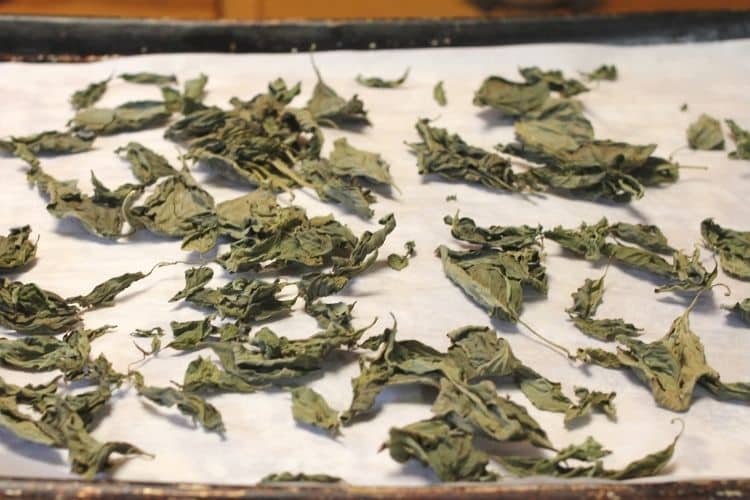
- Turn the oven off after about 15 minutes at 175°F and then check the basil a couple of hours later. If it’s not dry, heat the oven back to 175°F and then turn it off. Once the oven has cooled a second time the basil is usually completely dry.
- Store dried basil leaves in an airtight container. (see more below)

Drying Basil in a Dehydrator
Using a dehydrator is probably the easiest way to dry basil. But you’ll want to make sure your dehydrator has a temperature gauge.
I have three different dehydrators and I love them all for various reasons. One does not have a temperature gauge and I’ve learned that it gets too hot for drying herbs. You can often find dehydrators at thrift stores but if you want to buy a new one, I recommend this Nesco (I’ve had this same model for 20 years) or this Excalibur (I’ve had this model for 5 years).
Basil, like other herbs, are sensitive to heat and light. The heat will cause the volatile oils to be released – your house will smell amazing, but the dried basil will be bland. So, if your dehydrator does not have a temperature gauge then use one of the other methods for drying basil.
To dry basil in the dehydrator:
- Pinch the leaves off the stems and lay them in a single layer on the dehydrator trays. You can put them close together because they will shrink up quite a bit.
- Put the filled trays in the dehydrator and turn it on to the herb setting which should be below 115°F.
- It will take 6-12 hours for the basil to dry.
- Store dried basil in an airtight container.
Using a Microwave to Dry Basil
There are very few scenarios in which I think I’d need to dry fresh basil leaves in a microwave. The only one that comes to mind is if I needed some dried basil for a canning recipe and didn’t have any. In canning you can’t safely substitute fresh herbs for dried herbs. If that’s the case, microwave drying basil is the way to go.
To dry fresh basil in microwave:
- Line a microwave safe plate with a paper towel
- Lay the basil leaves on the paper towel
- Cover the basil leaves with another paper towel
- Microwave in 30 second increments. Check the leaves after each 30 seconds, flip or rearrange leaves as necessary to ensure even drying. Depending on your microwave it should take 1.5 to 3 minutes to dry the fresh basil.
- Store dried basil in an airtight container.
Using an Air Fryer to Make Dried Basil
Using an air fryer to dry fresh basil is another method that I don’t really see a need for. The air fryer can get to hot and you run the risk of burning the basil. But, if you need dried basil and only have fresh, the air fryer will work.
To dry fresh basil in an air fryer:
- Preheat the air fryer to 270°F
- Lay the fresh basil leaves in a single layer on the air fryer basket
- Cook the basil for 8-12 minutes, checking it often so it doesn’t burn.
- Store dried basil in an airtight container

At a Glance
Storing Properly
One of the things I’ve learned about storing dried basil is that the longer the leaves are kept whole, the more flavor it will have. Because of this, I prefer to store dried basil as whole leaves instead cut leaves.
If you’re going to keep the jars in a closed cabinet or pantry, a clear jar like a quart or half gallon mason jar is fine. However, if you keep your spices on open shelves, you should consider using colored jars to store them in.
Stored properly, dried basil should last a year or so. It will lose flavor the longer it’s stored but it won’t be unsafe to use.
It’s important to keep dried basil, and other herbs, in jars that have an airtight lid. And to not open them very often.
I like to keep a small jar in my pantry to use regularly, and then a larger jar to refill the small jar as needed. This keeps the basil from being exposed to air over and over.
If you live in a humid area, you might want to use food grade silica desiccant packs. Or use a food saver and vacuum seal the jars that you’re using to refill the small jar.
Substituting Dried for Fresh
You can easily substitute dried basil for fresh basil and vice versa if you know the ratio to use.
If a recipe calls for fresh basil, you’ll use 1/3 that amount in dried basil. So, if you need 1 tablespoon fresh basil, you’ll use 1 teaspoon dried basil.
If a recipe calls dried basil, you’ll use 3X that amount of fresh basil. So, if it calls for 1/2 teaspoon dried basil, you’ll use 1 1/2 teaspoons fresh basil.
How to Use Dried Basil
You probably don’t need much direction here but I thought I’d mention a few ways to incorporate dried basil into your meals.
Dried basil is a great addition to soups and sauces, of course. But it’s also great added to butter and garlic and spread on bread for a tasty garlic bread.
If you have a little more time, you can make fresh zucchini calzones and add dried basil.
The thing I mainly use dried basil for is in canning recipes. In case you didn’t know, you can add dried herbs to any canned recipe and not mess up the safety of the recipe. And y’all, that’s a game changer.

How to Dry Basil (in the oven or dehydrator)
Drying basil is a great way to preserve fresh basil. It can dried in the oven, dehydrator, or even hung to air dry.
Ingredients
- 3-4 bunches Fresh Basil Leaves
Instructions
Prepare the Basil:
Harvest basil using scissors or garden shears.
Wash basil in cold water.
Pinch the basil leaves off the stems.
Remove the excess moisture by putting the leaves in a salad spinner or by gently patting them dry with a clean kitchen towel.
Oven Method:
Lay the leaves out in a single layer on a baking sheet lined with parchment paper.
Turn the oven on to the lowest setting (usually 175-200°F) and put the filled baking sheet in the oven.
Turn the oven off after about 15 minutes and let the basil remain in the oven as it cools off. If they are not completely dry in a couple of hours, turn the oven back on and once it reaches 175°F turn it off. Let it cool with the basil in the oven.
Dehydrator Method:
Lay the leaves out in a single layer on the dehydrator trays.
Set the temperature to no higher than 115°F and put the filled trays in (or on) the dehydrator.
It should take about 6-12 hours for the basil to dry. But it could take longer.
It should take about 6-12 hours for the basil to dry. But it could take longer.
Storing:
The basil is completely dry when it crumbles easily and there's no obvious sign of moisture. It's shouldn't bend, it should break.
Store in an air tight jar out of direct sunlight. Try to keep the leaves whole as long as possible.
To use, crush the dried basil leaves with your fingers, a mortar and pestle, or food processor.
Notes
To air dry basil, tie into small bunches and hang in a cool dark place. It will take several days before it's fully dry.
If you have just a few leaves, they can be air dried on a plate for several days.
Nutrition Information:
Serving Size:Amount Per Serving: Unsaturated Fat: 0g

Angi Schneider is the author of The Ultimate Guide to Preserving Vegetables and Pressure Canning for Beginners and Beyond, both published by Page Street Publishing. She has taught canning classes for 177 Milk Street, been featured in Serious Eats, and written for Countryside Magazine. Angi has been sharing gardening, preserving, and simple living skills since 2010.
Thank you for sharing this information. I really learned from it. I grow basil indoors in Auckland, so I doubly appreciate the tips against humidity.
You’re welcome!
How long does the dried basil last?
When stored in an airtight container and out of sunlight it should stay flavorful for a year or so. The flavor will deteriorate over time, so you may need to use a bit more after a year, but it’s still safe to use.