
Bananas are one of the best fruits to keep in your dehydrating rotation -inexpensive, available year-round, and loved by just about everyone. When I find them marked down at the store because they’re getting brown, I buy as many as I can carry. They go straight into the dehydrator.
This post covers two things: banana chips (round slices) and banana jerky (long strips). They’re made the same way with slightly different results – chips are a bit more snackable, strips are chewier and more substantial. My kids and their friends have strong opinions about which is better. I stay out of it.
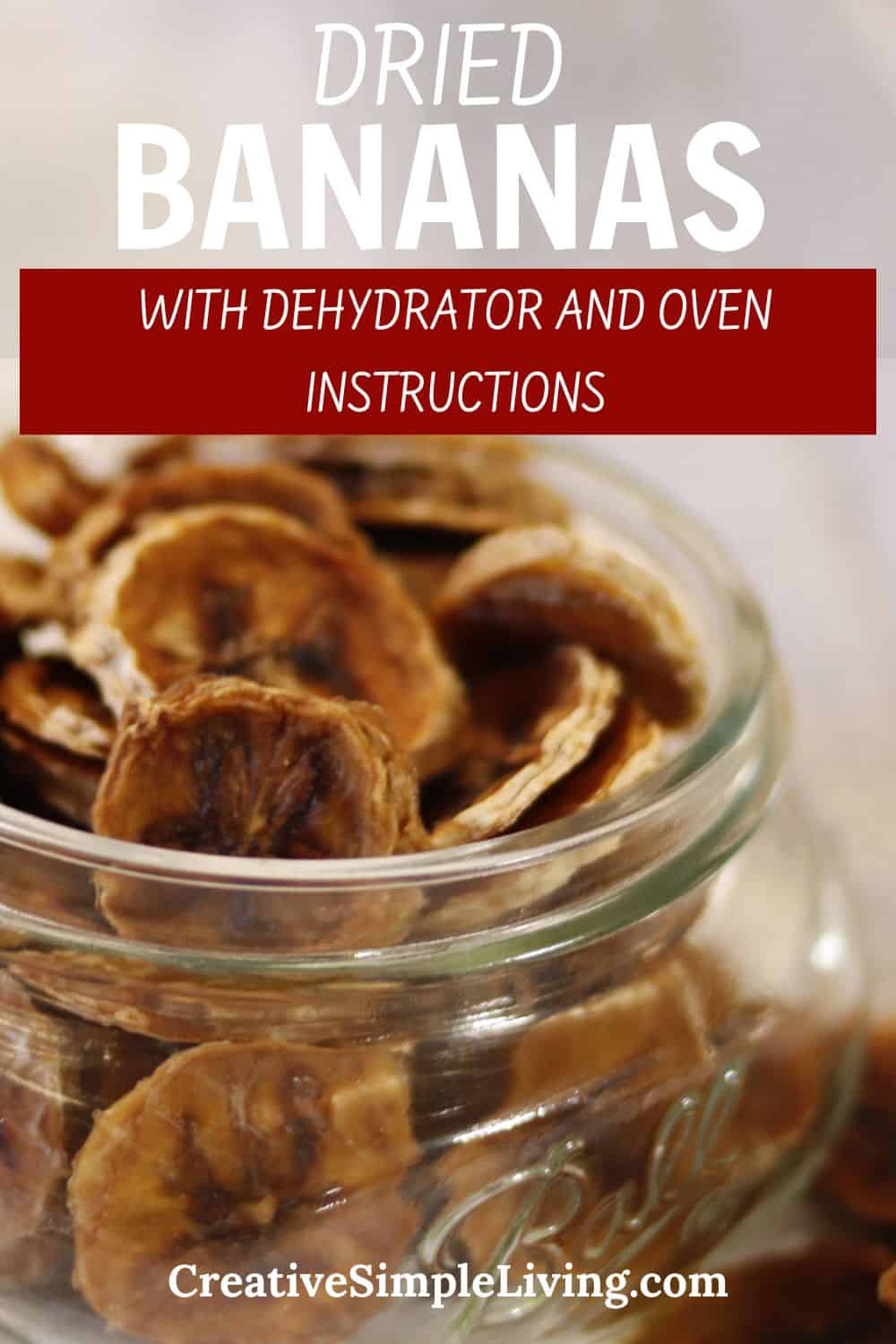
A quick note on what to expect: homemade dehydrated bananas will not be crispy like store-bought banana chips. Store-bought chips are usually fried. What you get from a dehydrator is chewy, sweet, and genuinely better once you stop comparing it to something else entirely.

What Makes These Dehydrated Bananas So Good
- So frugal! – Buying marked-down bananas and dehydrating them is one of the most frugal things you can do with fruit – a bunch that costs almost nothing turns into a snack that lasts a year.
- You control the texture – a shorter drying time gives you soft and chewy, longer gives you firmer and drier. The recipe tells you exactly how to tell when they’re done.
- No added sugar, no mystery ingredients, no oil (unless you want a crispier oven version). Just bananas.
- The conditioning step – which most recipes skip – is what actually makes them shelf stable for a year or more instead of going soft in the jar after a week.
Pro Tip: For best results, choose bananas that are firm with maybe just a few brown spots. Overripe bananas tend to be mushy, so use those for making banana bread muffins. Or freeze overripe bananas to use later.

Pre-treating Bananas
Like apples, bananas can turn dark when exposed to air. To slow down this process, bananas can be pre-treated, just dip banana slices water and an acid.
You can use 1/2 cup lemon juice in 1/2 gallon water or 3 finely crushed 500-mg vitamin C tablets in a 1/2 gallon of water. If you prefer to buy a commercial product there are a couple, Ball Fruit Fresh and Mrs. Wages Fresh Fruit Preserver, which are a mixture of ascorbic acid and citric acid which is the most effective mixture for preventing fresh fruits from browning.
Just know that lemon juice and vitamin C tablets are a lot cheaper.
You can also use any high acid fruit juice, such as pineapple juice. Just be aware that it will change the flavor a bit.

How to make banana jerky in the dehydrator
Banana jerky is just dehydrated banana sticks. Most of my kids prefer banana sticks to banana chips, I think because they’re chewier. I’m not a fan of either, but everyone else in my family (and my kids’ friends) love them.
To make dehydrated banana strips, peel the bananas and break them in half. We collect the banana peels to compost by burying them around various plants (trench composting.)
Divide each half into thirds. Bananas naturally have three sections so we just gently push our finger down the center lengthwise and the banana divides.
Pretreat the banana pieces if you don’t want them to turn brown (we don’t care so I usually skip this step.)
Lay the banana sticks on the dehydrator racks in a single layer. Put them in the dehydrator and turn the heat to at 135°F and dehydrate for 10-12 hours or until fully dry. If you want a crispier banana jerky turn the heat to 140°F, but you’ll need to check them earlier and more often to make sure the sugars don’t caramelize.
Start checking at the 10-hour mark. A finished banana strip should bend without snapping but feel dry to the touch, not tacky. The texture will firm up slightly more as it cools and conditions.
The drying time will vary depending on how much moisture is in the bananas, how humid your climate is and the temperature of your dehydrator.

How to make chewy dehydrated banana chips
To make dehydrated banana chips, peel the bananas and slice them into 1/4-inch slices. Collect the banana peels to compost.
Pretreat the sliced bananas, if you don’t want them to turn brown (we don’t care so I usually skip this step.)
Lay the banana chips on a dehydrator tray in a single layer. Put them in the dehydrator and turn the temperature to 135°F; it takes about 8 hours to dehydrate bananas chips. If you want a crispier banana chips turn the heat to 140°F, but you’ll need to check them earlier and more often to make sure the sugars don’t caramelize.
Start checking at the 8-hour mark. Remove a chip and let it cool for 10-15 minutes – warm banana chips always feel softer than they actually are once cooled. A properly dried banana chip should be leathery and pliable but not sticky.
If you tear it in half, no moisture should be visible at the tear. If it’s still sticky or shows moisture, return to the dehydrator and check again in an hour.

Oven instructions for dried banana chips
If you don’t have a dehydrator, using the oven is a good way to dry bananas. The process is pretty much the same as using a dehydrator, however, I would only do banana chips and not banana strips in the oven because of how long it takes to dehydrate them. Even as banana chips, they will take all day to dehydrate in the oven.
Prepare a baking sheet by putting a wire rack on it. You can also put parchment paper on the baking sheet to make clean-up a little easier. You can also brush the wire rack with a bit of oil to prevent the banana chips from sticking to the wire rack.
Peel and thinly slice bananas (1/4-inch slices).
Pretreat the banana slices, if desired.
Lay the banana slices out on the wire rack in a single layer. You can brush coconut oil on the banana slices for crunchy banana chips (they still won’t be as crunchy as store bought.)
Put the baking tray and rack with the banana slices on it in the oven on the lowest temperature possible. Ideally, this will be pretty close to 135°F which is the temperature for dehydrating fruit. If you’re oven doesn’t go down that low, you can use a wooden spoon to keep the oven door ajar to reduce the heat a bit.
While this is a good option if you don’t have a dehydrator, my family doesn’t care for dried banana chips made in the oven. They just don’t seem to get crispy enough.

If your banana chips are sticking to the trays…
This is a common issue, especially with riper bananas that have higher sugar content. A few things help: line trays with non-stick silicone mesh sheets (these work better than parchment or fruit leather sheets), flip the chips once halfway through drying, or lightly mist the trays with coconut oil spray before loading.
Don’t try to lift them while they’re still warm – let them cool on the tray first and they’ll release much more easily.
Storing dehydrated bananas
Once the bananas are done dehydrating, let them cool to room temperature, and then put them in an airtight container. Before storing, dried bananas, like all dehydrated fruit, needs to be conditioned.
Before putting them away, the dried bananas need to be conditioned, just like other dehydrated fruit.
After drying or pasteurizing, conditioning of dried foods is the last step before final storage.
For fruit, place the cooled product in a tightly sealed glass jar, shaking daily for 7–10 days. If condensation develops (inside of the jar), return to the dehydrator for more drying. Package dried food for long-term storage after conditioning for 10 days. Remember to keep food with high vitamin A or C out of direct sunlight during storage.
Ohio State University Extension
Fully dehydrated banana chips should store well for several months in an air-tight container. For long term storage, I store them in wide mouth quart size mason jars and use my food saver attachment to remove the air and seal the jar. Packaged this way, the shelf life is easily a year or more. If you don’t have a vacuum sealer, you can use an oxygen absorber.
Label jars and store in a cool, dark place.
How to use dried bananas
Dried bananas are a perfect snack all by themselves. But they can also be added to granola or trail mixes, used as toppings for cereal, oatmeal or yogurt. We also like to use the dried banana sticks to dip in peanut butter. Or they can be reconstituted.
Another way to dehydrate bananas is to make it into fruit leather and then dehydrate it.
How to reconstitute dehydrated bananas
Reconstituted dried bananas can be used like fresh bananas – obviously, they won’t be exactly like fresh bananas but they’re pretty close. To reconstitute dehydrated bananas put one part bananas to one part water in a sauce pan and simmer for 5 minutes.

Choosing a food dehydrator
Over the years I’ve used several different dehydrators and all of them have worked great. I prefer one that has an adjustable temperature gauge, but if you have one that doesn’t have a temperature gauge, it will still work just fine.
I have a Presto dehydrator that is inexpensive but doesn’t have a temperature control, so I tend to use is less than my other dehydrators. This one takes up the least space for storage, which is nice.
I have a Nesco dehydrator that I found at a garage sale for $5 that works great and does have a temperature control. If I’m doing a lot of trays, I end up having to move them around a bit to get even airflow.
When I was writing my first book, The Ultimate Guide to Preserving Vegetables, I bought the most basic Excalibur (at the time, they now have a smaller one) so I could see what all the hype was about. I do love the Excalibur dehydrator, but it’s expensive and it takes up more space (but not much more than the Nesco). One thing that I love about it, is that you can use it for things that require certain temperatures, like proofing bread and making yogurt. The other ones can’t be used for things like that since the trays stack.
Tried this recipe? Please leave a ⭐️⭐️⭐️⭐️⭐️ star rating in the recipe card below and/or a review in the comment section further down the page. We always appreciate your feedback. You can also save the recipe for later by pinning it or clicking on the heart in the lower right hand corner.

Chewy Dried Banana Chips Recipe
Chewy banana chips make a great snack! Use this recipe to make banana chips in the dehydrator or oven.
Ingredients
- 6 pounds bananas
- 1/2 cup lemon juice (or other acid for pretreatment)
- 1/2 gallon water
Instructions
- Peel the bananas. Set the peels aside for composting.
- For banana chips: slice bananas into ¼-inch rounds. For banana jerky: break each banana in half, then divide each half into thirds lengthwise — bananas naturally split into three sections, so just press your finger down the center and they'll divide easily.
- Optional: dip or spray banana pieces with a lemon juice and water mixture (1:1 ratio) to prevent browning. This step is purely cosmetic — skip it if you don't mind the bananas turning brown, which we usually do.
- Lay banana pieces in a single layer on dehydrator trays, leaving a little space between each piece for airflow.
- Dehydrate at 135°F. Banana chips take 8–12 hours; banana jerky strips take 18–24 hours. Start checking chips at 8 hours and jerky at 10 hours. To test doneness, remove a piece and let it cool for 10–15 minutes — it should feel leathery and dry, not sticky or tacky. For chips, tear one in half — no moisture should be visible at the tear.
- Once done, let the banana pieces cool completely to room temperature on the dehydrator trays.
- Transfer to glass jars and condition for 7–10 days: seal the jar and shake daily. If you see any condensation inside the jar, return the bananas to the dehydrator for more drying time.
- Label and store in a cool, dark place for up to a year. For longest shelf life, vacuum seal the jars or add an oxygen absorber.
Notes
This recipe can be scaled up or down depending on how many bananas you have.
The recommended ratio of lemon juice to water is 1:1 according the National Center for Home Food Preservation. In the older Ball Blue Book the recommended ratio is 4:1 - four cups water to one cup lemon juice. You can use as much or as little lemon juice as you want, or none at all, since this isn't a safety recommendation.
Recommended Products
As an Amazon Associate and member of other affiliate programs, I earn from qualifying purchases.

Frequently Asked Questions
Banana chips take 8-12 hours at 135°F. Banana jerky (long strips) takes longer – usually 18-24 hours at the same temperature because the strips are thicker. Both times can vary depending on the moisture content of your bananas, the humidity in your kitchen, and how your particular dehydrator runs. Start checking banana chips at 8 hours and jerky at 10 hours, and go by texture rather than the clock.
135°F is the standard temperature for dehydrating bananas and gives you a chewy result. If you prefer a slightly drier, firmer chip, you can run the dehydrator at 140°F – but watch them more closely at the end since the natural sugars can caramelize at higher temperatures. For the chewiest result, some people run at 125°F for a longer time (10–14 hours for chips).
That’s actually the goal with a home dehydrator – chewy is what you’re aiming for. Crispy banana chips like the ones at the store are almost always fried, not dehydrated. A home dehydrator produces a leathery, chewy texture that’s quite different. If you want crispier results, slice thinner than ¼ inch and run the dehydrator longer, but they likely won’t get as crispy as fried chips no matter what you do.
Stickiness usually means they need more time in the dehydrator, or that you’re testing them while they’re still warm. Let a chip cool completely before deciding – warm dehydrated bananas always feel stickier than they actually are. If they’re still sticky after cooling, return them to the dehydrator for another hour or two. High humidity in your kitchen can also cause finished chips to absorb moisture from the air during cooling – condition them quickly and get them into sealed jars.
For banana chips: remove a slice and let it cool for 10-15 minutes. It should be leathery and pliable, not sticky. Tear it in half – no moisture should be visible at the tear. For banana jerky: the strip should bend without snapping and feel dry to the touch, not tacky. When in doubt, give them more time – over-drying is much easier to recover from than under-drying, which causes spoilage during storage.
Properly dried and conditioned dehydrated bananas stored in airtight glass jars in a cool, dark place will last a year or more. The conditioning step – sealing them in a jar and shaking daily for 7-10 days to redistribute any remaining moisture – is what makes the difference between chips that stay good for a year and chips that go soft or develop mold after a few weeks. For longest shelf life, vacuum seal the jars with a FoodSaver attachment or add an oxygen absorber.
No – pretreating with lemon juice or vitamin C is optional and only affects color, not safety or flavor. Untreated bananas will turn brown during dehydrating, which looks less pretty but tastes exactly the same. We skip the pretreatment step here because we’re usually doing large batches and the browning doesn’t bother us. If you care about color – for gift-giving or trail mix where appearance matters – dip slices in a 1:1 mixture of lemon juice and water before loading the trays.
Yes, if your air fryer has a dehydrate function that goes down to 130-135°F. Set it to 130°F and check every hour for 3-4 hours. Not all air fryers can reach a low enough temperature for this – if yours only goes to 150°F or above, use the oven method instead.
Banana chips are round slices, about ¼ inch thick. Banana jerky is made from banana strips – peel the banana, break it in half, then divide each half into thirds lengthwise (bananas naturally divide into three sections). Chips dry faster (8-12 hours) and are more snackable. Jerky takes longer (18-24 hours) and is chewier and more substantial. Both are made at the same temperature with the same process – it’s just the shape and time that differ.

Angi Schneider is the author of The Ultimate Guide to Preserving Vegetables and Pressure Canning for Beginners and Beyond, both published by Page Street Publishing. She has taught canning classes for 177 Milk Street, been featured in Serious Eats, and written for Countryside Magazine. Angi has been sharing gardening, preserving, and simple living skills since 2010.
Question. Most recipes state lemon juice however also mention water. Usually there is no amount of each to mix. Why?
Hi Linda, that’s a very good question. I don’t normally dip my fruits in lemon juice or lemon juice and water because I don’t really care if they brown. But I know that’s not for everyone…lol. According to the National Center for Home Food Preservation the ratio of lemon juice to water is 1:1. So one cup lemon juice to one cup water. (https://nchfp.uga.edu/how/dry/csu_dry_fruits.pdf) Hope this helps.
I’ve made banana chips, want to try the banana jerky! I’ve gotten bananas at Costco very cheaply. Will try Sams.
I hope you like them. My kids and their friends love, love, love them!
Has anyone ever tried doing different fruits or veggies jerky soaked in beef jerky mix or anything other than beef? Hope this don’t sound stupid.
Hi Ronald, that doesn’t sound stupid at all. I’ve made savory dehydrated vegetables before, in fact, in my upcoming book The Ultimate Guide to Preserving Vegetables, there are several recipes for savory dehydrated vegetables. You’ll need to blanch the vegetable first and then soak it in the savory mix before you dehydrate them. My book will be out in early June and it has detailed instructions in it. My best advice is to just try small amounts and keep notes on what you try.
Having a vegetarian wife, I use my jerky mix to make her jerky using vegetable protein meat (I use farmland protein starters, because it works just like hamburger meat with my jerky gun). I only found a few things I have had to modify, so I can use the base mix for both my meat and her protein stuff is finding vegetarian things in the recipe that are not normal, such as worcestershire sauce. By accident, I found that one of my favorites, cajun power worcestershire sauce, was in fact vegetarian without even researching it first. I am not sure putting fruits and veggies in meat jerky sauce would taste very good.
Thanks for sharing your experience and knowledge, Jeffrey!
In the Ball blue book , it calls for 1 cup of lemon juice to 1 quart of water
There are quite a few different lemon juice recommendations for the lemon and water mixture. The National Center for Home Food Preservation recommends a 1:1 mixture. You can use whichever one you prefer – or none. We do so many at a time that I skip the lemon juice step.
I have dried bananas for many years. When our Boys were in school they took a brown bag lunch–usually including dried fruit of one kind or another. My method of drying bananas was to push my finget down the center of the banana lengthwise, not dip them in any citric acid and dry them. The finished prodect was what the Boys gleefully called “Dried Benena Sl;ugs”. You can imagine the fun they had taking “Dried Banana Slugs” to school for lunch!!!
What a fun memory! I’ll have to share that phrase with my grandson, he’ll love it!
HELP!!! My banana chips are firm and not sticky when I put them in a (lidded) jar for conditioning, but hours later they’re all stuck together and soft. Is this normal, or am I not dehydrating long enough? I’ve had this happen with cherries also.
If you live in a humid area this is more likely to happen. As long as there is no condensation in the jar they are dry enough. For long term storage I would suggest using silica (desiccant) packets or food saver bags (or using the food saver to seal the lid).
I have the done bananas a couple of times and I haven’t sprayed the crate or the parchment paper and they stick what am I doing wrong
Hmmm, I’m sure… these will not be as dry as store bought banana chips. Mine stick to the dehydrator trays some but not terribly bad. If the bananas are super ripe, they will be more sticky because they have more sugar content.