

Whenever I’m asked what I do with the extra eggs we get from our hens, I always say that we first freeze enough to make it through the winter. The other person usually looks confused and then says, “Can you freeze eggs?”
Yes, you can freeze eggs. In fact there are several ways of freezing chicken eggs to use later. The great thing is, when frozen and used correctly, frozen eggs don’t taste any different than fresh eggs.

During the spring and early summer our hens lay a ton of eggs – way more than we can eat fresh. We do share these eggs with friends and even sell a few here and there. But before we do any of that, I freeze eggs so that when the hens stop laying in the winter we don’t have to buy eggs from the store.
Unlike some other egg preservation methods, freezing eggs is completely safe and requires no special equipment.
My favorite way to freeze eggs is to freeze them whole and use ziplock bags (I’ll show you in a minute how I do that) but you can also freeze just the egg whites, just the yolks and cooked eggs such as scrambled eggs and hard boiled eggs.
There are a few things you need to do in order to successfully freeze eggs, so don’t just toss a whole egg in the freezer and call it good. The shell will crack and expose the egg which will lead to freezer burn and plain yolks don’t freeze well – they become very gelatinous.
When deciding how to freeze eggs start with the end in mind….how will you use frozen eggs? Do you want to use frozen eggs for baking? Do you want to use frozen eggs just like fresh eggs for things like omelets? Do you want eggs that are already cooked and all you have to do is thaw and heat up instead of cook them?
Why eggs change texture when frozen
Egg yolks contain proteins and natural emulsifiers that clump together when frozen. This is why plain frozen yolks become thick and gelatinous.
Egg whites, on the other hand, are mostly water and protein, so they freeze and thaw with fewer changes.
Adding salt or sugar to yolks alters the proteins slightly which keeps the mixture smoother after thawing.
How to freeze eggs
My personal opinion is that freezing the whole egg in ziplock bags is the most versatile way to preserve eggs. These eggs can be used to make scrambled eggs or omelets, used in baking or even for making ice cream.
I freeze eggs in a few different increments – 3 eggs per bag, 6 eggs per bag, and 1 dozen eggs per bag. I find that these work well for what we do. If I end up with a recipe that calls for two eggs, it’s never mattered that I used three.
Eggs come in all sizes and unless you’re making a super fussy recipe, it’s not going to mess up the recipe.
If it will matter for your recipe, you can measure the thawed eggs, just know that “officially” 3 tablespoons of whisked eggs = 1 whole egg.
The key to freezing whole eggs, is to mix the egg yolk and egg white together like you’re making scrambled eggs. That’s the secret. Whisking prevents the whites and yolks from separating and freezing unevenly.
Some people add a pinch of salt to their frozen eggs which helps keep the yolk from becoming so gelatinous. I usually don’t and they turn out just fine.

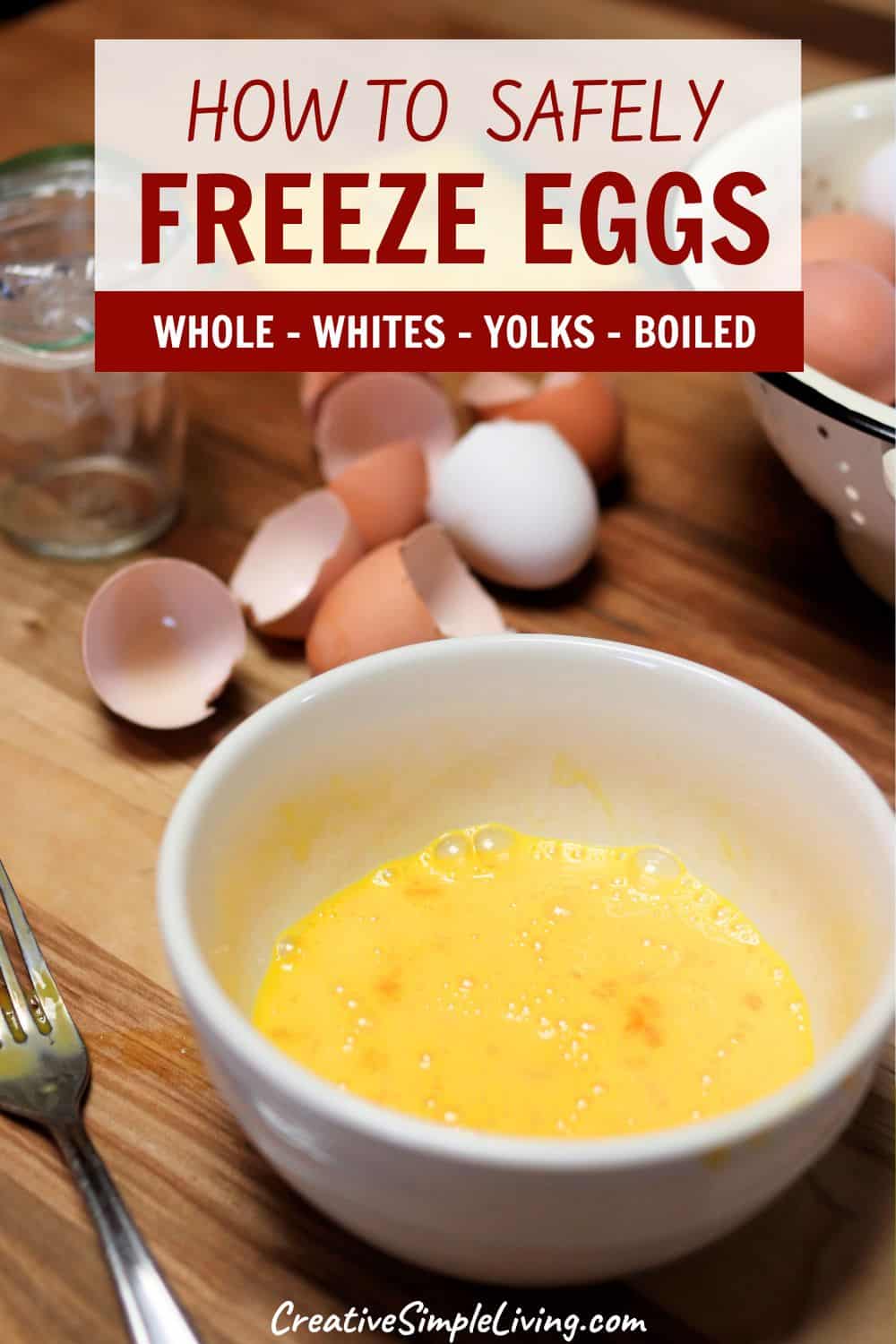
Crack the number of eggs you want to freeze into a bowl and whisk them together.
Write that number on a ziplock bag (do this before filling the bag).

Pour the whisked eggs into the bag and zip it up, try to get as much air out as possible.

Lay the bags of frozen eggs on a baking sheet and put in the freezer. This will ensure they freeze flat and take up less space. Once they are frozen they can be moved to a container (I use an reclaimed square ice cream bucket) and stored in the freezer.
Eggs can be frozen for up to a year, according to the USDA but for best texture use within 6 months. As long as the eggs stay frozen, they’re safe to use although the quality will continue to decline.
**If you’re really trying to reduce plastic in your home or don’t happen to have any ziplock bags, you can freeze the whisked eggs in ice cube trays or muffin tins (I would use silicone ones so it’s easier to remove them). Once they are frozen pop them out and put them into another storage container. To thaw them you’ll need to put the frozen egg puck in a bowl and let it slowly thaw out.

How to thaw frozen eggs
Frozen eggs thaw pretty quickly. I usually just put the bag of frozen eggs in a bowl of cold tap water. If the bag only has 3 eggs in it, it’s usually thawed out in about 5 minutes. If it has a dozen eggs it will take closer to 10 minutes and I’ll need to keep adding tap water to the bowl.
They can also be thawed out overnight in the refrigerator, just put them on plate or in bowl in case the bag in case the bag ripped while the eggs were freezing. This doesn’t happen often but it can happen.
Once thawed, the eggs will look a little thicker than they did before they were frozen. I promise, they will cook up just fine.
I usually cut a corner from the bottom of the ziplock bag and squirt the eggs out. This seems to be less messy than opening the bag from the top.
Don’t thaw eggs at room temperature (just sitting on the counter) since bacteria can multiply quickly. Always use a bowl of water if you’re not thawing them in the refrigerator.
The thawed eggs should be used within 24 hours and should never be refrozen.

Can you freeze egg whites?
Absolutely, in fact, eggs whites are the part of the egg that freezes best. There’s nothing special that you need to do, just put the egg whites in a ziplock bag, write the number of egg whites on the bag, and freeze flat. Thaw just like you would frozen whole eggs (see above).
Thawed egg whites will beat to better volume if you let them to sit at room temperature for about 30 minutes before beating.
If you want to freeze individual egg whites use an ice cube tray and then transfer the frozen egg whites to a freezer bag or other airtight container for storage.
If you have a recipe that call just for the egg yolks, there’s no need to toss the white or stress about finding something to do with it. You can easily just add the frozen egg white to the next batch of scrambled eggs or even a breakfast casserole, like this Baked French Toast.
For reference 2 tablespoons egg whites = 1 large egg white.
Can you freeze egg yolks?
Yes…but it needs this hack. I mentioned before that the egg yolk tends to get very gelatinous when frozen. To keep that from happening, mix in either 1/8 teaspoon salt per 4 yolks if you’ll use them in savory dishes, or 1 ½ teaspoons sugar per 4 yolks for baking. This prevents the yolks from gelling and becoming rubbery.
Once it’s mixed in put the egg yolks in a freezer bag and write the number of yolks on the bag. Be sure to label whether you mixed salt or sugar into the yolks so you can adjust the recipe you’re using them in.
This is great for those who have someone in their family who only eats the egg whites and not the yolks.
The frozen yolks can be thawed like you do frozen whole eggs (see above) and added to recipes to make them richer. While I use the whole egg when I make lemon curd traditionally only the yolk is used – these would be great for that.
For reference 1 tablespoon egg yolks = 1 large egg yolk.
Can you freeze hard boiled eggs?
Yes…but you probably don’t want to. When cooked egg whites are frozen without being whisked into the yolk, they get very rubbery. I’m all about freezing food that others don’t think should be frozen – but there’s no real use for the whites of a frozen hard boiled egg.
The recommended way to freeze hard boiled eggs is to remove the yolk from the boiled egg and just freeze the yolk and discard the whites. Put the yolks in freezer bag and remove the air. They can also be frozen on a baking sheet in a single layer and then put into a freezer bag if you’re worried about them getting squished together.
To me, that’s a waste. There’s no scenario in my life where I need only boiled egg yolks and not the whites.
That being said, if you have a family member who makes hard boiled eggs and only eats the whites, then yes, freeze the yolks. They can be added to things like egg or tuna salad.

Can you freeze scrambled eggs?
Absolutely and they are fantastic. When done correctly reheated frozen scrambled eggs taste pretty much like fresh scrambled eggs. So how do you freeze scrambled eggs?
First, don’t overcook the eggs – they need to look a little wet.
Add a little salt to the eggs to help them retain their moisture.
Let the eggs completely cool before freezing.
I don’t freeze scrambled eggs in large amounts, if we ever need a large amount of scrambled eggs we just make it fresh. However, I do use these eggs to make frozen breakfast tacos by putting them into a flour tortilla, rolling them up in a paper towel and then freezing them. When we want to use them, we just microwave them for a few minutes. It would be better if we would let them thaw overnight in the refrigerator but we never think of that.
You can also make and freeze egg casseroles. I will often freeze a whole casserole to use later or to take to someone in need. They can also be frozen in individual portions. egg bites freeze very well, too.
Once thawed, scrambled eggs, casseroles or egg bites should be eaten within 2–3 days and should not be refrozen.
Can you freeze eggs in the shell?
No, eggs should not be frozen whole (in the shell). Most likely, the shell will break and bacteria will be introduced into the egg. Also, the yolk will be very rubbery since no salt or sugar was mixed in.
It’s a waste of time and money to intentionally freeze eggs in the shell.
That being said, sometimes an egg will accidently get frozen in the coop or refrigerator. And those might be able to be used.
Can you use eggs that have been frozen?
If you follow the guidelines above it’s perfectly safe to use eggs that have been frozen. It’s recommended that you use them within 48 hours of removing from the freezer. And never refreeze thawed eggs.
But what about eggs you didn’t intend to freeze and are now frozen in the shell – for instance from the coop getting too cold or your refrigerator being too cold?
Can those frozen eggs be used?
According to the USDA it might be safe to use eggs that were frozen in their shell.
If the shell cracked, you should discard the egg.
If the egg froze but didn’t crack the shell, the egg is safe to use. Keep it frozen until your ready to use it – let it thaw in the refrigerator overnight.
Just know that the yolk will be gelatinous and it will not mix well with the whites or other ingredients. It’s best to just hard boil an egg that was frozen in the shell.
| Egg Type | Prep Before Freezing | Additives Needed? | Freezer Life | Best Uses | Notes |
|---|---|---|---|---|---|
| Whole Eggs (whisked) | Beat until blended; portion into bags or muffin tins | Optional: pinch salt or sugar | Up to 1 year | Baking, scrambled eggs | Do not freeze in shell |
| Egg Whites | Separate and freeze directly | None | Up to 1 year | Meringues, baking, omelets | Whip better if rested after thaw |
| Egg Yolks | Beat lightly; add salt (savory) or sugar (sweet) | Yes: 1/8 tsp salt OR 1½ tsp sugar per 4 yolks | Up to 1 year | Baking, custards, sauces | Label clearly with salt/sugar |
| Scrambled Eggs & Cooked Dishes | Cook fully, cool, freeze in portions | None | 2–3 months | Meal prep, casseroles | Use within 2–3 days of thawing |
| Boiled Eggs | Cook, cool, peel before freezing | None | Up to 1 month | Egg salad, chopped into dishes | Whites become rubbery; yolks freeze better |
Tried this recipe? Please leave a ⭐️⭐️⭐️⭐️⭐️ star rating in the recipe card below and/or a review in the comment section further down the page. We always appreciate your feedback. You can also save the recipe for later by pinning it or clicking on the heart in the lower right hand corner.

How to Freeze Eggs
Learn the best ways to freeze eggs—whole, whites, yolks, and even hard-boiled—so you can store extras safely and use them later for baking or meal prep.
Ingredients
- 12 Eggs
- Salt or Sugar, optional, for egg yolks
Instructions
Decide how to freeze - whole egg, just whites, just yolks, boiled
Whole eggs: Crack egg in bowl, beat lightly and portion into freezer bags or muffin tins.
Whites: Separate from yolk, no additive needed
Yolks: Separate from whites, beat with 1/8 tsp salt OR 1 ½ tsp sugar per 4 yolks.
Boiled eggs: Peel before freezing; expect rubbery whites.
Whites: Separate from yolk, no additive needed
Yolks: Separate from whites, beat with 1/8 tsp salt OR 1 ½ tsp sugar per 4 yolks.
Boiled eggs: Peel before freezing; expect rubbery whites.
Storing and Freezing
Put prepared eggs into a freezer bag.
Label bag with contents, date, and if sugar or salt was added.
Freeze flat.
Notes
Always thaw in the refrigerator or a bowl of cold water.
Use thawed eggs within 2 days.
Best for baking, scrambling, and meal prep—not sunny-side up or poached eggs.
Nutrition Information:
Yield: 6 Serving Size:Amount Per Serving: Unsaturated Fat: 0g
Freezing eggs is a simple way to avoid waste and always have fresh ingredients ready for baking or breakfast. Next time you have an egg surplus, try one of these methods and see which works best for you. If you’ve never frozen eggs before, start with a small batch of whites or scrambled eggs—you’ll be amazed at how handy they are to have on hand.
Preserving Food by Freezing
Freezing food is probably the easiest from of food preservation. There are a lot of foods that can be frozen that you’ve never thought would freeze well.
We love freezing mashed potatoes in the spring to use all year old. Of course, fruit such as berries and figs freeze incredibly well. There are also several herbs, cilantro and basil that retain there flavor better when they’re frozen.
Reference Sources for Freezing Eggs:

Angi Schneider is the author of The Ultimate Guide to Preserving Vegetables and Pressure Canning for Beginners and Beyond, both published by Page Street Publishing. She has taught canning classes for 177 Milk Street, been featured in Serious Eats, and written for Countryside Magazine. Angi has been sharing gardening, preserving, and simple living skills since 2010.
Wow, what an informative post. My daughter has chickens and I will definitely be passing this on to her!
This is quite illuminating, thank you. I knew you could freeze eggs I just didn’t know all of this! I keep my refrigerator very, very cold and I store my eggs in their cartons on the lowest shelf. Occasionally, one or more will freeze in their shell. Mostly it’s just partially frozen but it’s a shock when you go to crack it, lol. Sometimes the shell cracks on the bottom just enough to cause it to stick. Unless it’s in really bad or questionable shape, I use it. I’m usually preparing breakfast anyway and you can NOT tell the egg that was frozen.
Thank you SO much for this post! With today’s egg prices climbing to unbelievable heights, I think it is wise to watch for sales and then freeze them. I found Kroger eggs for $1.99 for 18 in their weekly ad – a miracle! – so want to freeze. I was sure you could but my knowledge was pretty old! Your post gave me everything I need to do this safely. Thank you so much!!
You’re so welcome! I’m glad it was helpful.
Great post. Very informative and helpful. I have 17 chickens of my own and have been on a learning curve for the past two years. A very laid back lifestyle and each chicken has its own personality. So much to learn, but such joy!
Chickens are so very fun! I’m glad you found the article helpful.
I’m definitely going to try this in my Souper cubes. i freeze in them all the
time, from a tablespoon size to 2 cups. Then i pop them out and vacuum seal them…..
Great idea! Thanks for sharing.