
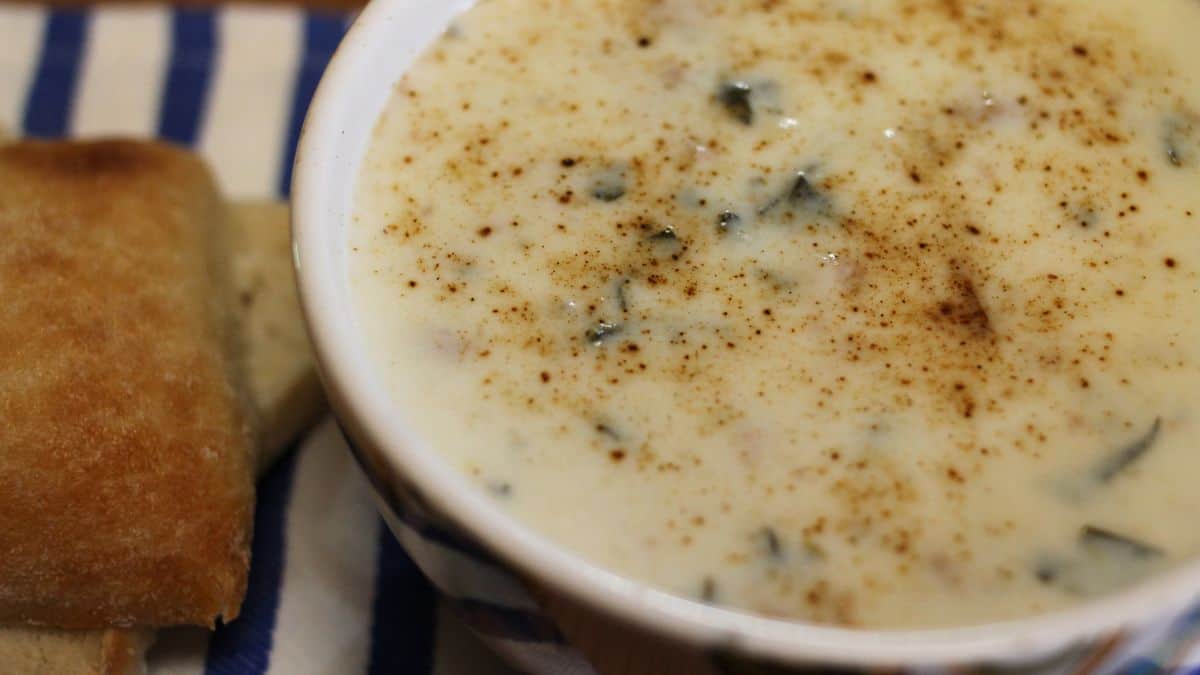
There are certain jars I always want on my pantry shelf — canned beef stew, chili con carne, and this sausage, potato and kale soup. It’s a copycat of Olive Garden’s Zuppa Toscana, and honestly I think the home canned version is better. You open the jar, heat it on the stove, stir in a splash of cream, and dinner is done in ten minutes.
I’ve been making this for years using venison sausage, but any ground sausage your family likes will work — beef, pork, or venison. The recipe is flexible in ways that matter and specific in ways that matter for safety.
A note before we start: this is a pressure canning recipe. There is no safe water bath alternative for a soup with meat and low-acid vegetables. If you don’t have a pressure canner yet, I’d encourage you to get one — they’re less intimidating than they look, and this soup is a good reason to start.
This recipe was reviewed for accuracy and food safety by Angi Schneider in August 2026. Processing times and methods follow safe soup canning guidelines from the National Center for Home Food Preservation (NCHFP).
What Makes This Soup Worth Canning
- A quart feeds two people and comes together in ten minutes once you open the jar – it’s exactly the kind of weeknight meal that makes a stocked pantry feel like a superpower.
- The recipe is based on safe soup canning guidelines from the NCHFP, using only ingredients with established tested canning times.
- The cream and thickener go in at serving, not in the jar – which means the soup stays shelf-stable and you get to finish it the way you like it.
Safe Canning
To can sausage, potato and kale soup, you need a pressure canner. In fact, to can any meat, legume, and vegetable that isn’t pickled or jammed you need a pressure canner. There is no other safe way.
If you’re new to using a pressure canner, I assure you there is no reason to be scared. Just follow the manufacturers instructions and everything will be fine. Here are some tips for using a pressure canner.
If you don’t have a pressure canner, you can still make this recipe, but you’ll want to freeze it. And yes, the potatoes will probably fall apart.
Another idea is to leave out the potatoes and freeze the soup. Then dehydrate the potatoes and when you cook the soup, put it on early and add the dehydrated potatoes.
This recipe is not a lab tested recipe, it’s a recipe I developed based on the safe soup canning guidelines from the National Center for Home Food Preservation.

Ingredients for Sausage, Potato and Kale Soup
While I have my own way of doing things in my kitchen, I think it’s important to discuss the ingredients and what you can safely substitute based on your family’s preferences and what you have on hand.
If you just want the recipe, there’s a printable recipe at the bottom of this post. Feel free to scroll down and print it up.
Sausage
I usually use ground venison sausage, but you can use whatever ground sausage your family likes. This can be beef, pork, or venison.
Tube or link sausage works well too – just slice it rather than crumbling. But cured meats are not recommended for canning because their density changes during processing.
If your sausage contains sage, be aware it can turn slightly bitter during the canning process — adding cream at serving usually takes care of this.
Potatoes
Red, white, and Yukon Gold potatoes hold up better in the canner than high-starch varieties like russet. Sweet potatoes, turnips, and rutabaga can also be substituted.
Peel all potatoes regardless of variety — this is a food safety requirement for canning, not just a preference.
Normally when canning potatoes , they need to be parboiled and then packed in jars with fresh hot water. That doesn’t seem to be the recommendation when adding potatoes to a soup or stew.
I’ve scoured the National Center for Home Food Preservation’s website, plus looked a soup recipes on the Ball website and in several of their books and I cannot find a mixed soup recipe that has parboiling potatoes in the instructions.
If parboiling the potatoes make you feel more comfortable then feel free to do that. I choose not to do that extra step.
Kale
While any hearty green can be substituted for the kale, for canning I prefer kale for several reasons. The first is that is holds up to the canning process better than a more tender green like spinach or chard will.
The second reason is that it’s still available in my garden in the summer when it’s too hot for all other greens. And I need to can this soup in the early summer when the potatoes are ready.
Cabbage is not a recommended vegetable for canning.
Beans (optional)
If you want to add white beans or Great Northern beans, soak them overnight and simmer for 30 minutes before adding to the soup — they’ll finish cooking in the canner.
Just remember, you only fill each jar no more than halfway with solids and top off with broth; beans absorb liquid as they cook and will expand.
Spices
My personal opinion is that the spices that are in the sausage I use makes a fantastic flavored soup. The meat will be fully cooked before you put it into jar, I suggest that you taste the broth and see if it’s flavorful enough for you.
If you think the soup needs more spice you can add any DRIED spice you want and in any amounts you want. Just remember, you can always add more seasonings when you serve the soup, so go easy on the spices.
Some suggested spices to add are salt, pepper, red pepper flakes, oregano, and thyme.
If you want more delicious pressure canned recipes to stock your pantry shelves, be sure to check out my book, Pressure Canning for Beginners and Beyond.
Keeping Track of Preserved Food
While I love preserving food, I hate waste. So I track what I preserve and what we actually use so I make sure to use what I preserve. If you’d like to get the worksheets that I use so you can keep track of your preserved foods, just fill out the form below and they will be emailed to you.
Canning Sausage, Potato and Kale Soup
In a large stockpot, brown the sausage. While it’s cooking wash the vegetables, peel the potatoes, and chop the potatoes and kale.
When the sausage is cooked, add the vegetables to the stock pot and cover with water. You can add chicken broth if you have it but I think it’s flavorful enough without the broth.
Bring to a boil ,then reduce the heat to a simmer and simmer for 10 minutes.
While the soup is simmering, prepare the jars, lids, and pressure canner. The jars don’t need to be sterilized but they do need to be washed in hot soapy water and kept hot. The lids need to be washed, too.
Prepare the pressure canner according to the manufacturers instructions. This will probably include putting the rack in the bottom and adding a few inches of water. Heat the water but don’t bring it to a boil.
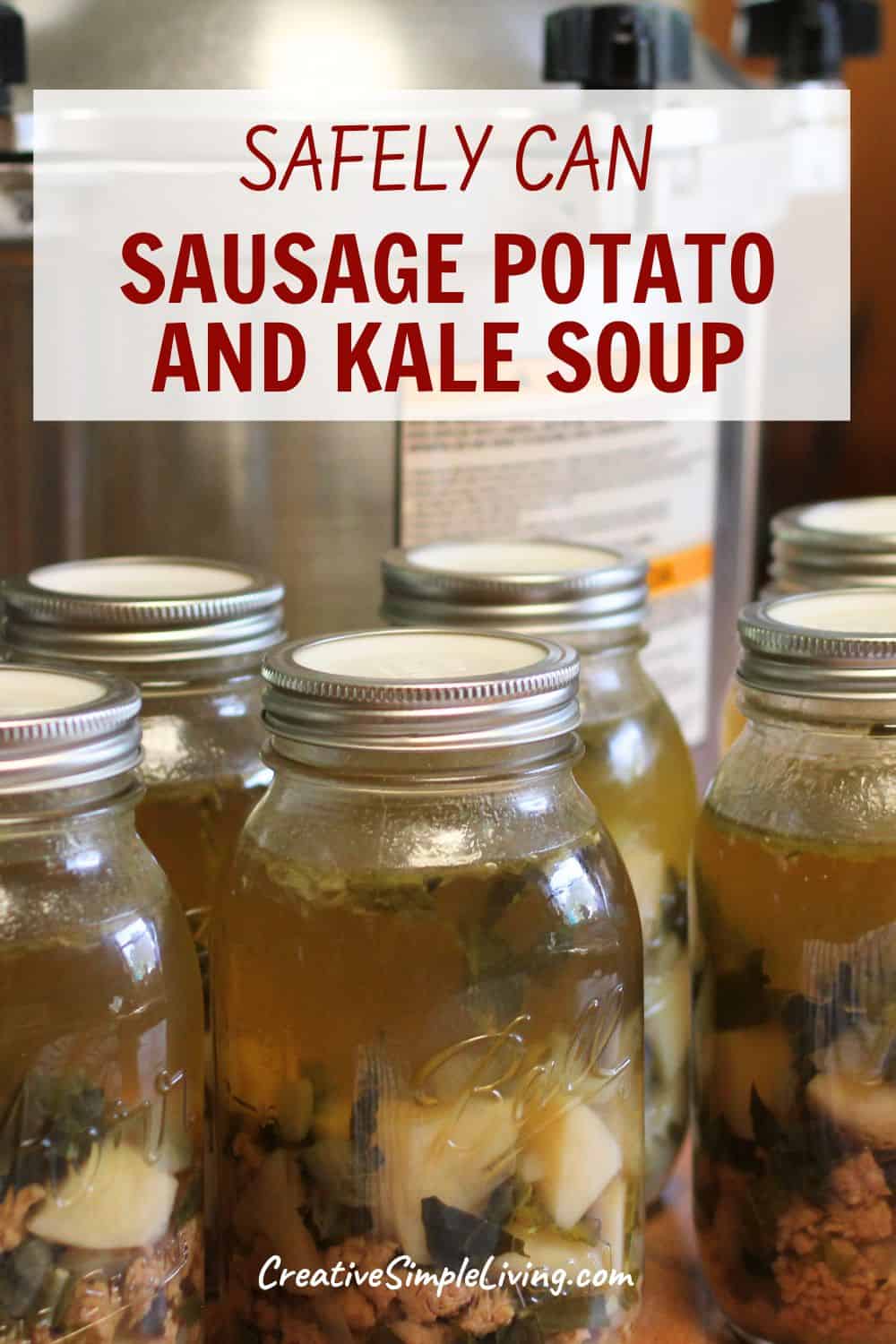
Ladle the soup into the clean, hot jars leaving a one inch head space. I like to ladle the solids into each jar first so that they each have about the same amount. Then I divide the broth between the jars. If I end up short I’ll add hot water to each jar until they each have a one inch head space.
This way I don’t end up with on jar that has lots of meat and potatoes and one that’s mostly broth and kale.
Wipe the rims with a clean, damp cloth. Put the lids and bands on the jars and load them into the pressure canner. Process the filled quart jars for 90 minutes at 10psi adjusting for altitude, if needed. Here’s what you need to know about adjusting for altitude.
Follow the processing instructions that came with your pressure canner.
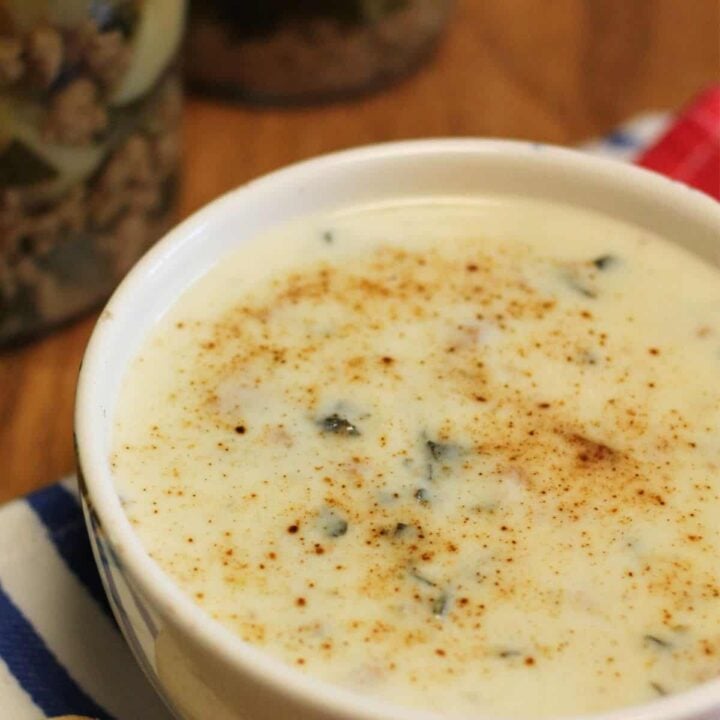
Canned Sausage, Potato and Kale Soup Recipe
Canned sausage, potato and kale soup is delicious, shelf stable soup that will make your weeknight meals a snap.
Ingredients
- 3 pounds ground sausage
- 7 pounds potatoes (peeled and cubed)
- 1 pound kale
- 10 cups water (or broth and water combination)
- 2 tbsp non-iodized salt
- 2 tsp ground black pepper
For Serving
- Whole milk, cream, or half and half
- Arrowroot or other thickening agent
Instructions
- In a large stockpot, brown the sausage. While it's cooking wash the vegetables, peel the potatoes, and chop the potatoes and kale.
- When the sausage is cooked, add the vegetables to the stock pot and cover with water. You can add chicken broth if you have it but I think it's flavorful enough without the broth.
- Bring to a boil ,then reduce the heat to a simmer and simmer for 10 minutes.
- While the soup is simmering, prepare the jars, lids, and pressure canner. The jars don't need to be sterilized but they do need to be washed in hot soapy water and kept hot. The lids need to be washed, too.
- Prepare the pressure canner according to the manufacturers instructions. This will probably include putting the rack in the bottom and adding a few inches of water. Heat the water but don't bring it to a boil.
- Ladle the soup into the clean, hot jars leaving a one inch head space. I like to ladle the solids into each jar first so that they each have about the same amount. Then I divide the broth between the jars. If I end up short I'll add hot water to each jar until they each have a one inch head space.
- Wipe the rims with a clean, damp cloth. Put the lids and bands on the jars and load them into the pressure canner. Process the filled jars for 90 minutes at 10psi adjusting for altitude if needed.
- Follow the processing instructions that came with your pressure canner.
Notes
To serve, empty jar into a stockpot and heat over medium heat. Add cream to make it a creamy soup.
If you want a thicker soup, use arrowroot, flour, cornstarch, or other thickening agent.
**This recipe makes 7 quarts. Each quart can serve two people. Therefore, this recipe has 14 servings in it.
Recommended Products
As an Amazon Associate and member of other affiliate programs, I earn from qualifying purchases.


Nutrition Information:
Yield: 14 Serving Size: 1Amount Per Serving: Calories: 645Total Fat: 30gSaturated Fat: 10gTrans Fat: 0gUnsaturated Fat: 15gCholesterol: 64mgSodium: 863mgCarbohydrates: 75gFiber: 9gSugar: 7gProtein: 22g
Frequently Asked Questions
Yes – no exceptions. Any soup containing meat, potatoes, or other low-acid vegetables must be pressure canned. Water bath canning is not safe for this recipe and cannot be made safe by adjusting the recipe. If you don’t have a pressure canner, freeze the soup instead – it keeps well for 2–3 months, though the potatoes will soften.
Pints: 75 minutes. Quarts: 90 minutes. Both at 10 PSI, adjusting for altitude. If you’re above 2,000 feet, you need to adjust for altitude.
Yes — chicken broth adds flavor and is a fine substitute for all or part of the water. Homemade or store-bought both work.
Yes. Both are safe to add in reasonable amounts. Brown them with the sausage for best flavor. Onions and garlic are low-acid vegetables with established canning safety at the processing times used here.
Yes – carrots and other standard soup vegetables that can be canned alone can safely be added. Keep the ratio of solids to liquid in mind: fill each jar no more than halfway with solids and top off with broth. Overcrowding jars with solids is the most common mistake in soup canning and affects both safety and quality.
Dairy products are not safe to can at home – the high heat causes them to separate and can affect heat penetration, which is a food safety concern. Thickeners like cornstarch and flour also interfere with heat penetration during processing. Add both at the stove when you’re ready to serve.
No – Cured meats are not recommended for canning because the density and fat content change unpredictably during processing. Stick to fresh or cooked sausages.
Sage in sausage is the most common culprit – it can turn bitter during the long canning process. Adding cream at serving usually corrects this. If you’re sensitive to this, choose a sausage without sage or use an Italian-style sausage seasoned with fennel and red pepper instead.
No – there are no established safe processing times for soups in half-pint jars. Stick to pints (75 minutes) or quarts (90 minutes).
Properly sealed jars stored in a cool, dark place will maintain quality for 1–2 years.
Other Canned Soups
Home canned soups and stews are a great way to preserve the harvest, prepare for emergencies and crazy days when things don’t go as planned. Every summer when the tomato harvest is at it’s heaviest, be sure to make plenty of jars of canned beef stew and canned chili con carne for the winter.

Angi Schneider is the author of The Ultimate Guide to Preserving Vegetables and Pressure Canning for Beginners and Beyond, both published by Page Street Publishing. She has taught canning classes for 177 Milk Street, been featured in Serious Eats, and written for Countryside Magazine. Angi has been sharing gardening, preserving, and simple living skills since 2010.
Thanks for pointing that out. The recipe yields 7 quarts as is stated on the recipe card, but one quart serves two people. So there are 14 servings in this recipe but only 7 quarts.
Hi I’m wondering if we have to use ground sausage or if we can use a tube sausage like kielbasa? It’s what I normally in my recipe sausage kale soup. If I can use it, would I just boil it like I normally would and add to your above recipe? Also is it ok to add sliced carrots? We love them in our soup
Yes, you can use tube sausage for canning. And you can use carrots. Just make sure not to stuff the jars full of solids. When you create your own soup recipe for canning, it is recommended that you only fill the jar halfway with solids and the rest with broth.
I have a son that would happily eat this soup every day. I normally cook a double batch and freeze it in single servings to have an easy lunch option for him, so I can verify that the soup does well in the freezer. The potatoes, we use red or white as you reccomend, seem to hold up pretty well. I can’t tell you how long it retains good flavor and consistency because it generally doesn’t last more than a couple of weeks, but I would expect it to be fine for atleadt a couple of months.
I realized that I might be able to can it, and free up some space in my freezer. I am so happy to find that you have already done so. Thank you for sharing this recipe!
You’re welcome, Ceri!
Hi Lori. Yes, the other 7 are okay. Just bring the leftover soup back to a boil and then fill the hot jars.
Do you need to add canning salt to the jars?
No. When pressure canning, salt is added for flavor and to help retain color (like when canning green beans) not for preserving. So there salt doesn’t have to be added.
90 min for quarts or pints?
Quarts.
@Angi Schneider, how long would it be for pints? Thanks!
75 minutes for pints
@Angi Schneider,
I would like to do half pints for single servings. How long would you pressure can for?
There are no recommended times for canning soups in half pints.
Do I need to cook the potatoes /kale for 10 minutes? It seems the pressure cooking would cook the potatoes/kale..and maybe overcook them if they are cooked already .
This sounds tasty! Could you tell me if I can forgo boiling the potatoes before canning?
I boil for 10 minutes but the official recommendation for canning your own soup recipe is to boil the mixture for 5 minutes before packing into the jars. This ensures the mixture is hot before jarring.
Could white beans be safely added to this recipe?
Yes, you need to soak them overnight and then cook them for 30 minutes before adding to the soup mix. They won’t be fully cooked, they’ll finish cooking in the canner. Just be sure to only fill each jar halfway with solids and top off with the broth/liquid….the beans will soak up some of the liquid as they finish cooking.
Hmmm, if you left a one inch headspace in the jar (meaning there was 1″ between the food and the rim of the jar before adding the lid) and processed them for the correct time, they are safe to eat. However, the food that is not covered in liquid will begin to discolor over time. So, you might want to use these first.
Hi! Thanks for this recipe. Do I need to make any adjustments if I omit the meat or could I substitute Great Northern beans?
You can leave it out, the processing time will be less. You would use the processing times for canning potatoes. I don’t know how many beans would be a good substitute for the meat. Both are processed for 75 min for pints and 90 min for quarts so there would be no changes in timing if you substituted.
This sounds so good and I’m going to have to try it…..I’m putting it on my “get in line” list! This is my daughters favorite Olive Garden soup, and I make a pretty good stove top version but canning it would make an awesome special gift for her, as well as a nice option for us too. I’ve been canning for 60+ years and even though I totally understand the reasoning for it, I just hate that it requires the end user to add cream and thickener…..unless you enjoy it without the cream. She’s a hairdresser and enjoys quick and easy things to take for lunch on busy work days but she’ll figure out how to make it work for her, ; ^) Thank you for this recipe and another good thing is, you can always use store bought potatoes if you don’t have home grown.
Hi. I’ve read all the comments and am confused. Will this make 7 or 14 quarts with the listed amounts? Thanks.
It makes 7 quarts and each quart serves 2 people, so there are 14 servings.
any way to sub out the potato’s for like rutabaga or turnups
Yes, you can use turnips or rutabaga instead of potatoes
I’m sorry. I got interrupted & passed over your comment about no safe canning instructions for cabbage. Can anything other than kale be used?
Spinach can be used
Hi! Can you substitute the crumbled sausage with spicy cured chorizo? Can the soup be pureed first then sausage added before canning?
Good questions. Cured meats are not recommended for canning because their density changes. And no, the soup cannot be pureed before canning, for the same reason.
I am really excited to try this recipe. I was browsing thru your pressure canning book, which I recommend every chance I get, and came across this recipe. As soon as my kale is ready in the garden I will be making it. This is my favorite soup. thanks!
How much whole milk, cream, half & half do you add to a quart of canned soup when serving?
I don’t really measure it but I’d estimate that I usually add about 1/4 cup half and half when I make it. Less if I’m using heavy cream and more if I’m using milk. Hope that helps.
Can you use chicken broth instead of water?
yes