
Every summer when we juice our Mustang grapes, I end up with gallons of grape mash left over from the steam juicer. For years I felt a little guilty about how much of it went to waste — all that fruit, all that flavor, just composted. Then I figured out I could turn it into grape jam, and now I look forward to the mash almost as much as I look forward to the juice.
This grape jam recipe works two ways: with leftover grape mash from making grape juice, or with whole fresh grapes when you have a bag sitting on the counter that nobody’s eating. Both methods use the same ratio and the same process. No pectin needed — grapes have plenty of natural pectin on their own, especially in the skins.
We water bath can ours so it’s shelf stable for a year, but if you’d rather just make a small batch for the refrigerator, that works too.
This recipe was reviewed for accuracy and food safety by Angi Schneider in [August 2026]. All processing times and methods follow tested guidelines from the USDA and the National Center for Home Food Preservation (NCHFP).
What Makes This Grape Jam So Good
- Using leftover grape mash from juicing means practically nothing goes to waste – 8 gallons of grapes can become juice, jelly, jam, and pie filling with very little left to compost.
- No pectin needed. Grapes – especially wild varieties like Mustang grapes – have plenty of natural pectin in the skins. A long, slow cook is all it takes to get a firm set.
- The ratio-based approach means you can make as much or as little as you have mash for. You’re not locked into a precise recipe.
- Made with whole Mustang grapes, this jam has a tartness that store-bought grape jam just doesn’t have – it tastes like actual grapes.
What’s the Difference Between Grape Jam and Grape Jelly?
Grape jelly is made from strained grape juice – clear, smooth, no bits of fruit. Grape jam is made from crushed or mashed grapes – it has texture, color from the skins, and a more complex flavor than jelly.
If you’ve only ever had store-bought grape jelly, homemade grape jam will taste noticeably different – more like actual grapes, less like candy. Both are delicious; they’re just different products.

Making Grape Must
Grape must is crushed grape juice with the seeds, skin, and even stems in it, and is the first step in wine making.
Grape mash is the left over stuff from making grape juice. The easiest way to juice grapes is with a steam juicer.
For years I juiced grapes by boiling them down and then squeezing the mash through a jelly strainer. It’s fun but super time consuming and messy. My life was changed when I got the steam juicer.
Mustang grapes have seeds so after they’ve been juiced I put the mash from the steamer in a food mill and remove all the seeds. It’s super easy.
If your grapes don’t have seeds you don’t need a food mill. You can use a regular blender, food processor, or immersion blender to break the grapes up and make grape mash.
But usually even seedless grapes have small seeds in them.
Grape jam can be made with or without the skins. I think the skins add tartness and more flavor to grape jam and we like that. If you don’t want the skins in the jam, you can peel the grapes or use a food mill.
Preparing Whole Grapes
To make grape jam with the whole grape you’ll want to use the skin to give the jam texture and color but not the seeds.
If you use a food mill, it will remove the seeds but it will also remove the skin. If you want to keep the skin you’ll need to remove the seeds by hand.
The seeds can be removed a couple of different ways. The first way is to cut each grape in half and take out the seeds.
The second way would be to peel the grapes and put the peels in one bowl and the pulp with the seed in another bowl. Then press the pulp through a mesh strainer or food mill.
Some grapes will be easier to peel than other – green Thompson grapes are more time consuming but mustang grapes can easily be squished out of their skin.
Either way, this can be time consuming but that doesn’t mean it’s not worth it. These are the types of jobs that cause us to slow down. Jobs that keep our hands busy but our minds free. Jobs that when done with others spur good conversation. Jobs that when done alone allow you to be still, listen to music or an audiobook and enjoy the moment.

Making Grape Jam
Now you’re ready to make the grape jam. The first thing you want to do is put three or four metal spoons in the freezer. You’ll want these later, I promise.
Because every time we process grapes we end up with a different amount of grape mash I don’t use a precise recipe for grape jam – instead I use a ratio.
Unlike when you make jelly and need precise amounts of sugar, acid, and pectin to make it gel, when you make jam, you can leave out the pectin and just cook the jam until it reduces down and gels.
Mustang grapes are tart, if there were a tartness scale for grapes, like the spicy scale for peppers, mustang grapes would be at the top of the scale.
If the grapes you’re using aren’t as tart you might not need as much sugar. If you use mustang grapes, you might want to use even more sure than I do since we like our grape jam tart.
I use 2 cups of sugar and 1 tablespoon lemon juice for every 3 cups of grape mash.
Mix the grape mash, sugar, and lemon juice together in a stainless steel stock pot. Bring the jam to a boil and then cook over medium heat until it gels.
If you have a lot of juice in the grape mash, it will take a long time, just be patient and let it cook. If you’re using mash that’s leftover from making grape juice, it won’t take as long since most of the juice is already extracted.
Stir the mixture often to keep it from sticking to the bottom of the pan, as the liquid evaporates its more likely that the jam will stick.
To test the jam to see if it’s going to gel when it cools, get one of the spoons you put in the freezer earlier. Dip the back of the spoon into the jam. Give it just a moment and then touch the jam, if it has gelled on the spoon it will gel in the jar when it cools off. If it’s still runny, it needs to cook down more.
How to Test Grape Jam for Gelling
There are two reliable ways to test grape jam for gelling; use either or both:
The frozen spoon test: Put three or four metal spoons in the freezer before you start cooking. When you think the jam might be ready, pull out a cold spoon and dip the back of it into the jam. Give it a few seconds then touch it – if it has set on the spoon and doesn’t run when you tilt it, the jam will gel in the jar. If it’s still runny, keep cooking and test again in 5 minutes.
The thermometer test: Grape jam reaches gel stage at 220°F at sea level. If you have a candy thermometer, clip it to the side of the pot and cook until the jam registers 220°F. This is the most reliable method, especially for your first batch.
Important: Give the canned jam 48 hours to fully set before you open a jar to test it. Grape jam often looks loose right after canning and firms up considerably as it cools and rests. Opening a jar at 24 hours and thinking the jam failed is one of the most common mistakes with this recipe.

Canning Grape Jam
While the jam is cooking down, prepare the water bath canner by filling it with water. You’ll need enough water so that the jars are completely covered by at least one inch water. Turn the heat on medium and put the lid on.
If you’re new to canning, here are some tips for water bath canning to help you out.
The jars and lids need to be washed in warm, soapy water and kept warm until filled with jam. I like to put the jars in the water bath canner until I need them.
There’s no need to sterilize the jars because they will be processed in the water bath for 10 minutes. But if you want to sterilize them by boiling them for 10 minutes, you can. If you have a dishwasher you can use that to clean the jars and keep them warm.
When the jam is cooked down and ready to be jarred, put the jars on a kitchen towel on the counter and ladle the hot grape jam into the hot jars leaving 1/4-inch headspace. When the jars are full, wipe the rims with a damp cloth, and add the lids and bands.
There’s no need to put the bands on super duper tight, just put it on like you would put a lid on the mayonnaise before putting it in the refrigerator.
Put the filled jars in the water bath canner and turn the heat up. Once the water starts to boil, set the timer for 10 minutes (adjusting for altitude) – this is the processing time. And yes, water bath processing is necessary in order to know that your safely canning the jam.
Adjusting for altitude? Processing times change above 1,000 feet. Use the altitude adjustment guide and calculator to find the right time for your elevation.
After 10 minutes remove the jars from the water bath canner and let them cool on a kitchen towel on the counter. The next day you can remove the bands and check the seals. Wipe down the outside of the jars and store in the pantry. If any of the jars didn’t seal, you can store them in the refrigerator and use them first.
I like to keep track of all my home preserved food so I know exactly what I preserved and how much we actually used that year. You can get a blank copy of these worksheets emailed to you by filling out the form below.
What Are Those Crystals in My Grape Jam?
If you open a jar of grape jam and find small crystals in it, don’t panic — they’re tartrate crystals, sometimes called wine diamonds. They’re a natural byproduct of the tartaric acid in grapes and are completely harmless. They can appear more frequently in jam made from high-tannin grapes like Mustang or Concord varieties. The texture is slightly different but the flavor is unaffected. We eat ours and just appreciate the reminder that we made this from real grapes.
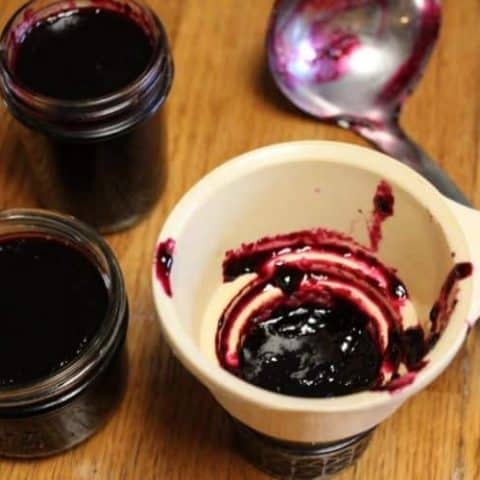
Grape Jam Recipe (Using Grape Mash)
This grape jam is practically free when you use the grape mash (grape must) from making grape jelly or grape juice.
Ingredients
- 3 cups grape mash
- 2 cups sugar
- 1 tbsp lemon juice
Instructions
- Put a couple of spoons in the freezer. You'll use these later to test the jam for gelling.
- Prepare a water bath canner by filling it about 2/3 of the way full with water.
- Wash the jars and lids in hot soapy water. Keep the jars hot until you need them.
- Mix the grape mash, sugar, and lemon juice together in a stainless steel stock pot. Bring the jam to a boil and then cook over medium heat until it gels. If you have a lot of liquid in the grape mash it will take a while.
- Stir the mixture often to keep it from sticking to the bottom of the pan, as the liquid evaporates its more likely that the jam will stick.
- To test the jam to see if it's going to gel when it cools, get one of the spoons you put in the freezer earlier. Dip the back of the spoon into the jam. Give it just a moment and then touch the jam, if it has gelled on the spoon it will gel in the jar when it cools off. If it's still runny, it needs to cook down more.
- When the jam is cooked down and ready to be jarred, put the jars on a kitchen towel on the counter and ladle the hot grape jam into the hot jars. Leave 1/4-inch headspace
- When the jars are full, wipe the rims with a damp cloth, and add the lids and bands.
- There's no need to put the bands on super duper tight, just put it on like you would put a lid on the mayonnaise before putting it in the refrigerator.
- Put the filled jars in the water bath canner and turn the heat up. Once the water starts to boil, set the timer for 10 minutes adjusting for altitude - this is the processing time.
- When the jars are finished processing, remove them from the water bath canner and put them on a kitchen towel on the counter. Let them cool.
- After 12 hours or overnight, remove the the bands from the jars and test the seals. If any jar failed to seal, put it in the refrigerator and use first. Store the sealed jars in the pantry.
Frequently Asked Questions
Yes! And this recipe does exactly that. Grapes are naturally high in pectin, especially in the skins, which means they’ll gel on their own with enough cooking time. The key is cooking the jam long enough to reach gel stage (220°F or the frozen spoon test) and not rushing it. No-pectin grape jam has a deeper, more complex flavor than pectin-set versions because the longer cook time concentrates the grape flavor.
Grape mash (sometimes called grape must) is the leftover skins, pulp, and fiber from juicing grapes. After running grapes through a steam juicer, you’re left with a mash that still has plenty of flavor and natural pectin. Running it through a food mill removes the seeds, and what you have left is perfect for jam. It’s a great zero-waste approach to get juice and jam from the same batch of grapes.
This recipe uses 2 cups of sugar and 1 tablespoon of lemon juice for every 3 cups of grape mash. This is a ratio rather than a fixed recipe, so you can scale up or down based on how much mash you have. If your grapes are very sweet, you can reduce the sugar slightly. If they’re very tart (like Mustang grapes), you may want a little more.
It’s optional in this recipe. Grapes are already naturally acidic, so the lemon juice is added for flavor rather than for pectin activation or food safety. If you don’t want the lemon flavor, leave it out – the jam will still set and still be safe to can.
Yes! Seedless table grapes work well and are a great way to use up grapes that have been sitting in the refrigerator. You don’t need a food mill for seedless grapes; just blend or mash them before cooking. Keep in mind that most seedless grapes are lower in natural pectin than seeded wild varieties, so the jam may need to cook longer to reach gel stage.
Water bath canned grape jam stored in a cool, dark place will last up to 12 months. Once opened, store in the refrigerator and use within 3-4 weeks. If you’re not canning, refrigerate the jam immediately and use within 3-4 weeks.
Those are tartrate crystals which are completely harmless and a natural byproduct of the tartaric acid in grapes. They appear more often in jam made from high-tannin wild grapes like Mustang or Concord. The texture is slightly different but the flavor is the same. They’re sometimes called wine diamonds for the same reason you see them in bottles of wine.
Yes – just halve or quarter the recipe and store the finished jam in the refrigerator. It will keep for 3-4 weeks. No water bath processing needed for refrigerator jam.
Jelly is made from strained grape juice so it’s clear and smooth with no fruit pieces. Jam is made from mashed or crushed fruit so it has texture, bits of skin, and a richer flavor. Jam is generally easier to make at home because you don’t need to strain the juice. Jelly requires more fruit to make the same amount of finished product since so much is strained out.
The most common reasons are: not cooking long enough, too much liquid in the mash, or testing the jam before it’s had time to fully set. Make sure you’re cooking to 220°F or passing the frozen spoon test before jarring. Then give the canned jam at least 48 hours to rest before testing – grape jam often looks loose right after canning and firms up considerably as it cools.

Angi Schneider is the author of The Ultimate Guide to Preserving Vegetables and Pressure Canning for Beginners and Beyond, both published by Page Street Publishing. She has taught canning classes for 177 Milk Street, been featured in Serious Eats, and written for Countryside Magazine. Angi has been sharing gardening, preserving, and simple living skills since 2010.
Angi, Grapes are high in pectin already, I was surprised by the addition of lemon juice in your recipe.
Yes, they are. I added the lemon juice just for flavor not for added pectin. It can certainly be left out.
@Angi Schneider, how do you get the seeds out
I use a food mill.
Your recipe couldn’t have come at a better time! I’d just finished steam juicing our grapes and was wondering what to do with all the leftover mash. Thank you! I’ve just made the jam, and it looks and tastes delicious! I’m just processing it now, while I wipe up all of the little purple spatter spots from my stove 😉
Glad it helped!
Ditto from me!! I just finished making grape juice and felt “guilty” for throwing out the leftovers. Great timing – finding your recipe 🙂
Yay! Glad you found it. The mash masks a great pie too!
I’m going to try this today! Thanks for the recipe
Good afternoon thank you for your blog a lot of great ideas. Do you know where I can get some Meyer lemon seeds, I have looked around and I cannot get a Meyer lemon tree start they will not ship to California. I work long 12 hour shifts in the Er and sometimes I am to tired to continue the search. If you know someone that will sell me some seeds please let me know. Thank you so much
Hey Rose, instead of seeds, I would suggest buying a Meyer lemon tree locally or from a California nursery like Four Wind Growers. If you want to try growing them from seed, just buy a Meyer lemon from the grocery store and harvest the seeds.
I have made grape jam using concord grapes, wash cook down in pan everything, stems , grapes little water 1o min. Then we put hot grape mixture thru a chinos pushed pulp into large bowl. Used the low sugar pectin to make jam. Turned out perfect was awesome. BUT know after using a few jars that were excellent we are noticing that tartrate crystals are forming.in the rest. Is there some way to save the jam. We made a total of 45 jars. I have had a problem with it in the past but rarely. I looked for info before on a process to avoid that happening without any luck. All info was for jelly or juice. Any help would be greatly appreciated.
Hmmmm, I don’t know of any way to get rid of the tartrate crystals in grape jam. I’ve not had that issue with our grape jam. I have had it happen to grape jelly in the past but we still eat it and just appreciate the new texture.
When making must form mash, do you remove the stems before processing it through the apple sauce mixer?
We try to remove most of the stem when we put the grapes in the steam juicer but we don’t worry about getting all the stems, the filter on the food mill with filter them out.
I will be making grape juice over the next two days and don’t have a steam juicer or food mill.
How can I make this jam without that equipment?
You can juice the grapes by cooking and smashing them, then draining them through cheese cloth or a strainer lined with cheese cloth. I’m not sure how you would get the seeds and skin separated without a food mill though.
Thank you for the recipe, really liked it. However a question re canning. I live in the UK and don’t have a canner, is there an alternative method?
Normally I pour my relishes hot into hot sterilised screw lid jars, wipe clean the tops and seal after which I invert the jars until cold so seal is formed. Any help/suggestions would be greatly appreciated.
You don’t have to have a canner to water bath can, just use a large pot and put something on the bottom to keep the jars from touching the bottom of the pan – you can use a layer of jar rings or even a kitchen towel. I know that in the UK many people use the inverted method to can pickled food and full sugar jams and jellies, however, the USDA does not recommended that method any longer. I don’t use that method so I really can’t comment on it. Hope that helps.
As far as making the wild grape jam which is what I was looking for, I would like to add that the things most people throw away are actually the best parts, as I myself have found out after battling hormone fed breast cancer.. First of all those dark grapes that have not been sprayed are filled with resveratrol in the skins, and the grape seeds block the estrogen which women like myself need to do so as not to feed our cancer. I had been sending for alternative sources, and one was grape seed extract when in fact I can and do make it myself.. In fact I use the entire grape, skin, seeds, juice, I make jam, sometimes jelly for my husband even then, I dehydrate those seeds and skins and pulverize them into powder. I also completely dry the grapes to make my own grape seed extract, in other words my body needs those seeds more than anything, so don’t throw that mash away find a way to use it as it is very healthy.
Hi, I can’t figure out how to remove seeds but keep skins and pulp! I have exactly the same machine that you have pictured, but the output from the strainer in your photo looks magical vs. actual from my experience using it. I have tried warming and softening the grapes. I have tried different sized strainers. I have tried mashing and then putting through multiple times, etc. The output from the photo in the blog looks too good to be true. Can you please elaborate on what steps and what attachments you used for that machine (size of mesh, type of piston), number of iterations, etc? THANK YOU
Hey Joe, I’m so sorry you’re having trouble with the strainer. The pulp that I stained was what was leftover from making juice with the steam juicer, so the pulp and skin were already really soft from being steamed. I don’t remember which screen I used, next summer I’ll try to remember to make a note of the screen size and edit the article. But it was probably the “standard” one or the “pumpkin” one and the “grape” spiral. I only sent the batch through the mill once.